The Stieff family answers questions


The Stieff family answers questions

Below are excerpts from conversations and correspondence with
Charles Clinton Stieff III, and James Stieff as they
answers some of my questions about
the Stieff Company. There is no particular order.
I have seen some of those quarter sized tokens with the post 1930 Stieff building on them, and someone’s name engraved on the reverse. Are these something that was given to people that took the tour at the factory.. or were they given to people that bought silver.. or both. The engraving on the coins seems to be hand engraving… and seems like a lot of work to have been done, really fast to give to someone taking the tour.
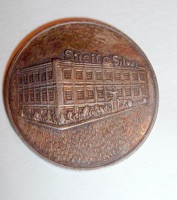
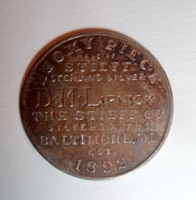
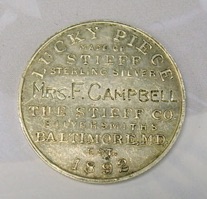
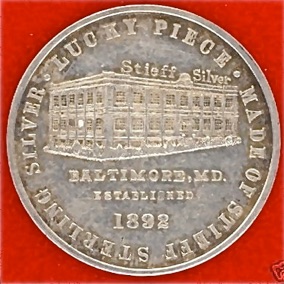
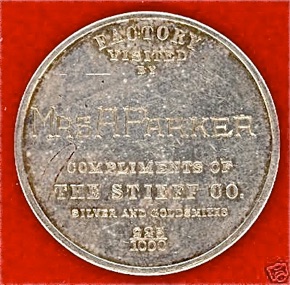
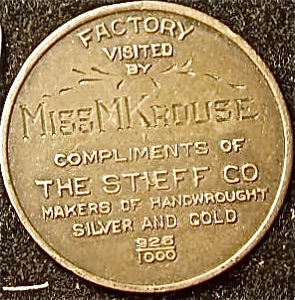

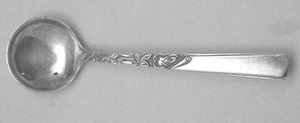

Coin and pin images from ebay
CCSIII: Given to people who took the tour. Engraved on the spot.
JS: The factory had a lot of schools taking the tour. At the end the people were offered the choice of a “lucky token” or a spoon pin in various patterns. The tokens were given out until the late 1960’s or early 70’s when we switched to pewter. A lot of the pewter ones ended up in soda machines.
Editors note: On the Stieff Ad’s page, a 1955 promotion gave away the spoon pins when you registered your pattern and bought a place setting. I do not know how long these type of promotions existed.
Click here for more information on these pieces.
Stieff Lucky Pieces and Spoon Pins
When did production on hollow ware end?
CCSIII: (We) Could still make sterling hollow ware up to the end in Baltimore (1990) but there was really no demand. There was some demand in the 1970's, but this market had seen its hay day.
During WWII, was silver production stopped?
JS: No. There was silver produced through out the war.. but at reduced levels. The pieces produced were thinner than our normal silver and had a special mark to indicate the thinner material. I do not remember what that mark was. I will try to look that up and get back to you.
Concerning the background of the Stieff Family, I had asked Charles about the Stieff Piano business and his side of the family’s involvement in it.
CCSIII: I would love to share what information I have for you to use.
You might be interested in a short history of my family. Charles Maximilian Stieff came to Baltimore from Germany in 1831 and taught. In 1841 he began to import piano's to sell from Europe.
John Lewis Stieff was his first of 8 children born in 1831. John decided at the age of 16 in 1848 to go West to California to make his fortune in the gold fields. His obituary would say at this time he had become "tired of the school room." He left with $17 in his pocket. He kept a diary which I have and would have numerous experiences but finally made it to San Francisco on July 31 of 1850 by way of Mexico and over the Sierra Madre mountains. He would eventually go into partnership with another person selling supplies to the goldminers but also digging for gold on the side. He was successful with both. On one day he found $3000 worth of gold (which is $74,000 in todays dollars)
In 1852 John decided to return to Baltimore for a visit... He would arrive to find his father in poor health and was persuaded to take charge of the business. John would eventually begin the manufacture of Charles M Stieff pianos in Baltimore. The business grew tremendously.
In 1876 John sold out his interest to his brothers.
John would have two sons. His second was Charles Clinton Stieff who would start the silver business.
I am from Virginia originally. In a conversation, Mr. Stieff provided this piece of background.
CCSIII: Being from The South you might be interested to know John L Stieff sent as a gift to Robert E Lee a Chas M Stieff piano when he became President of Washington & Lee University in 1865. Inscribed in the piano are the words To Robert E Lee.
(The Lee family history shows the piano was presented in November 1865.)
This piano still sits in the Presidents House at W&L which is where I and my brother got our degrees.
Below are trade cards, a 19th century method of advertising, from the business of the brother of Charles C. Stieff at the same address as Charles Business, 17 N. Liberty Street. Their father owned the building.
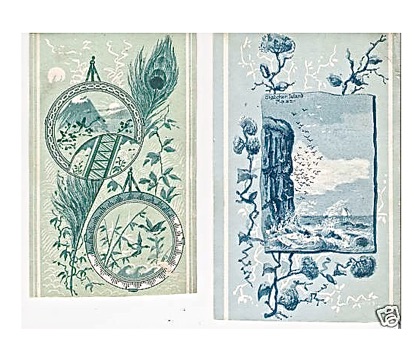
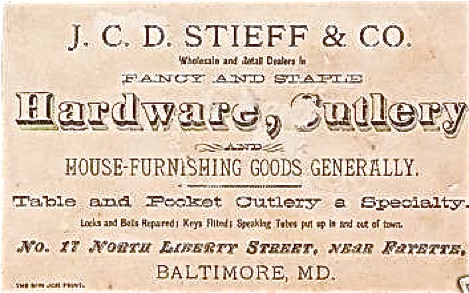
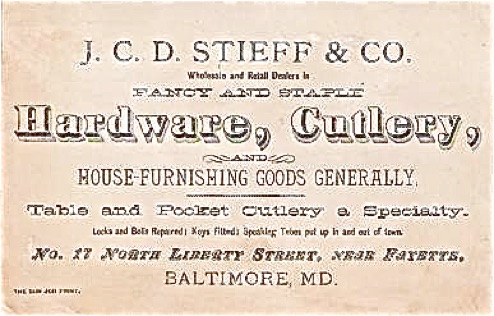
Note: the printer of the trade cards appears to be the Balt. Sun The cards are undated.
I asked Charles C. Stieff III who this brother was.
CCS III: John Christian Dieter Stieff was the first child of John L. Stieff and brother of Charles C. Stieff I. I do not have much information about him but do know he did own a hardware store in Baltimore but it was not at Liberty Street. He was married many times and had a falling out with his father.
A google search for JCD Stieff came up with this wedding announcement in the Baltimore Daily News on December 7, 1878
STIEFF-WORNHORST. On 28th November, at the residence of the bride's parents, by Rev. I.. C. Burkhalter, J. C. D. STIEFF to LENA A. WORNHORST, ll
of Baltimore
(Sometimes even a storied family can learn something about the family tree from a small piece of paper. It appears that JCD Stieff did have a business on Liberty Street. Perhaps he moved it when he and his father had the falling out. When the father died, the building would go to Charles C. Stieff.)
In a conversation at the home of Charles and Priscilla Stieff II, Charles III told us a funny story. He was telling his parents that when he was a small boy eating at his grandparents home (Priscilla’s parents)... They sometimes used KIRK silver at the table and that he used to pick up the Kirk silver-ware with his napkin as he was afraid to touch the Kirk silver (one wonders what was going through the mind of this small boy.. did he think that Kirk silver would burn him or something?).
Charles II commented that when he and Priscilla were dating, that he once commented to her mother that he would have to stop dating her daughter....if they kept serving him with Kirk silver. She must have hid that that silver or something because he obviously kept coming around.
To be continued as the conversations with the Stieff family continue.
